The AI-Native Operating Model
Part three of three. The method we use at Baser Potential to turn the six moves into a running system.
Larry Chao · August 13, 2026
In part one I described Allie K. Miller's company of one, thirty-four agents held together by one person's discipline. In part two I argued the enterprise version of that discipline is infrastructure, and named six moves her own language already implies. How does an organization actually make those moves without a two-year platform program? What follows is the method we use, stripped of jargon wherever the jargon can be spared.
The first decision is where to start, and the answer is smaller than most companies want to hear. The common failure pattern runs in two directions at once, a hundred ungoverned pilots nobody can account for, or a governance committee that ships documents and no working system. Miller's bottleneck rule points the better way. Find the bottlenecks, price the fixes, pick the high-value one, ignore the rest. We add one axis to her three. Pick the workflow where the win can be proven, because a win you cannot prove earns you nothing, and the whole game is earning the next increment of autonomy. High value times provable is the selection function. One workflow, chosen that way, beats a hundred pilots.
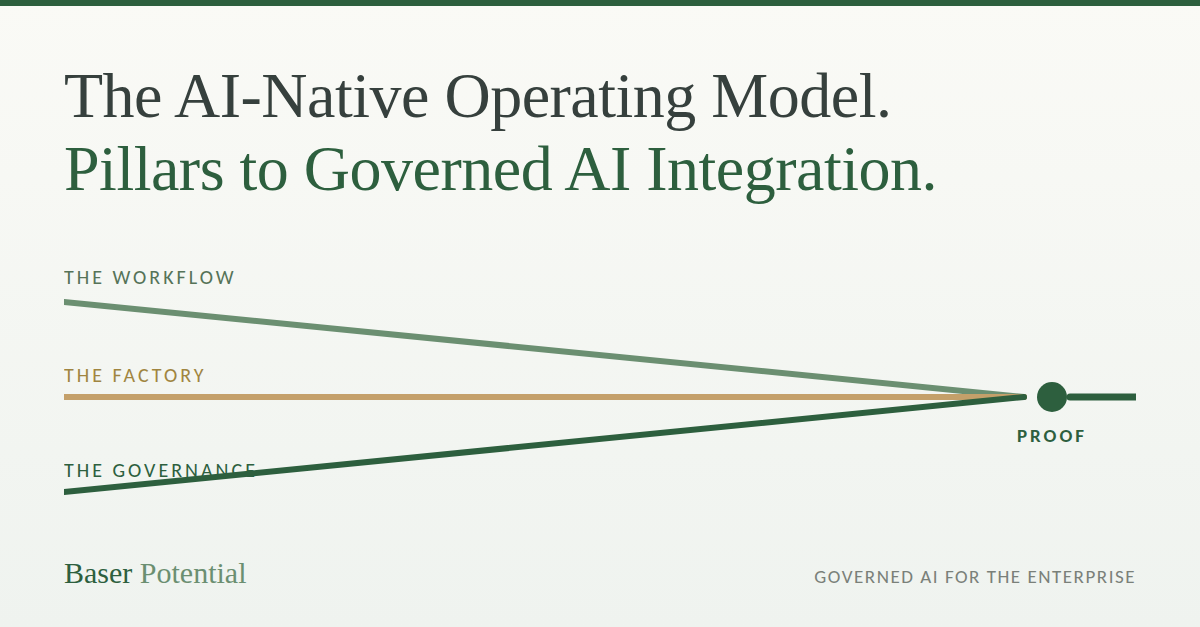
From there the work runs on three tracks in parallel, and each track answers to something she built alone.
Track one is the workflow itself. Take one slice of real work, name its owners, and measure the baseline, meaning how the work actually happens today, in hours and steps and error rates. Then declare the trust boundary in writing. What may the system do on its own, what may it only draft, what may it never touch, and who is the named human at each gate. Miller runs this boundary from memory, and "I still check all the emails" is a trust boundary stated as a habit. Writing it down is how the boundary keeps working on the days its author is unavailable.
Track two is the factory, which is her context corpus made institutional. Her three-word prompt works because months of context sit underneath it. The company version of that corpus has a shape. Intent lives in a registry, versioned and owned, stating what the company is trying to achieve and why. Specs compile that intent into working systems instead of leaving it in slide decks. The daily diary grows up into a decision record any teammate, or any agent, can query. When people ask why we spend early weeks on specs and registries, the answer is Miller's own line played at company scale. A prompt can only be short when the context under it is complete, and specs are how a company completes its context.
Track three is the system of intelligence, the part that makes the other two safe to speed up. Every agent request travels inside an envelope stating who is asking, under what authority, touching which data, with which tools. Policy decides what the envelope permits, enforcement carries out the decision, and evidence records what happened, all as separate concerns. Readers of part two will recognize the building code, with its breaker and its inspector. The envelope is also where liability stops being a vibe. When something goes wrong, the record shows what was authorized, by whom, on what basis, which is the difference between an incident and a scandal.
The three tracks meet in a weekly cadence, and the grounding rule matters more than the meeting. Every status is graded against the recorded meeting record and the evidence, never against optimism. Our dashboards honor her complaint about dashboards. They exist to say what changed this week, what is blocked, and what needs a decision from a named person, with the supporting record one click away. Insight into action, with receipts attached.
Autonomy, in this method, is earned rather than assumed. The trust boundary widens one increment at a time, and only when the evidence shows the last increment held. Breadth expands while the tier of risk stays put, her rule upgraded from a personal promise into a property of the system. Nobody has to remember to check all the emails, because the gate remembers on their behalf.
Ninety days of this buys a specific bundle. One governed workflow running in production against a measured baseline. Factory primitives that make the second workflow cheaper than the first, which is her dark headless factory with authority and evidence on the shelf. And an evidence record that answers who is liable now without anyone reconstructing events from Slack. That last item compounds furthest, because structured intent and evidence are what let learnings travel, between teams inside one company, or across a portfolio of them.
Her closing advice was to start with one agent and lean into the weirdness. Ours rhymes with it. Start with one workflow, and write down the authority. The weirdness takes care of itself.
The method above is the work we do at Baser Potential. If you want to see it run against your own first workflow, I would enjoy the conversation.
Previously in the series: Part One, "The Company of One, Running Thirty-Four Agents", a full tour of Miller's system. Part Two, "Where the Agent Workforce Goes From Here", the six moves this method delivers.