The Company of One, Running Thirty-Four Agents
Part one of three. What Allie K. Miller's AI workforce actually looks like, drawn from her workshop with Mark Cuban and her conversation with Greg Isenberg.
Larry Chao · August 11, 2026
I watched Allie K. Miller walk through her AI workforce twice this week, first in a two-hour workshop with Mark Cuban, then in a sit-down with Greg Isenberg that is now circulating everywhere in clips. Plenty of executives have heard about the 34-agent company of one. Far fewer have seen the whole system, so before I offer any commentary of my own, here is what she has actually built.
Start with the mindset, because she insists everything else follows from it. She rejects the manager-of-agents frame outright. In her analogy you are the electrical engineer for the building rather than the electrician managing the crew. You set up the wiring, you decide what is safe, you let the electricians work out the details, and you come in when something needs your signature. Her phrase for the change is moving from managing to waiting for escalations.
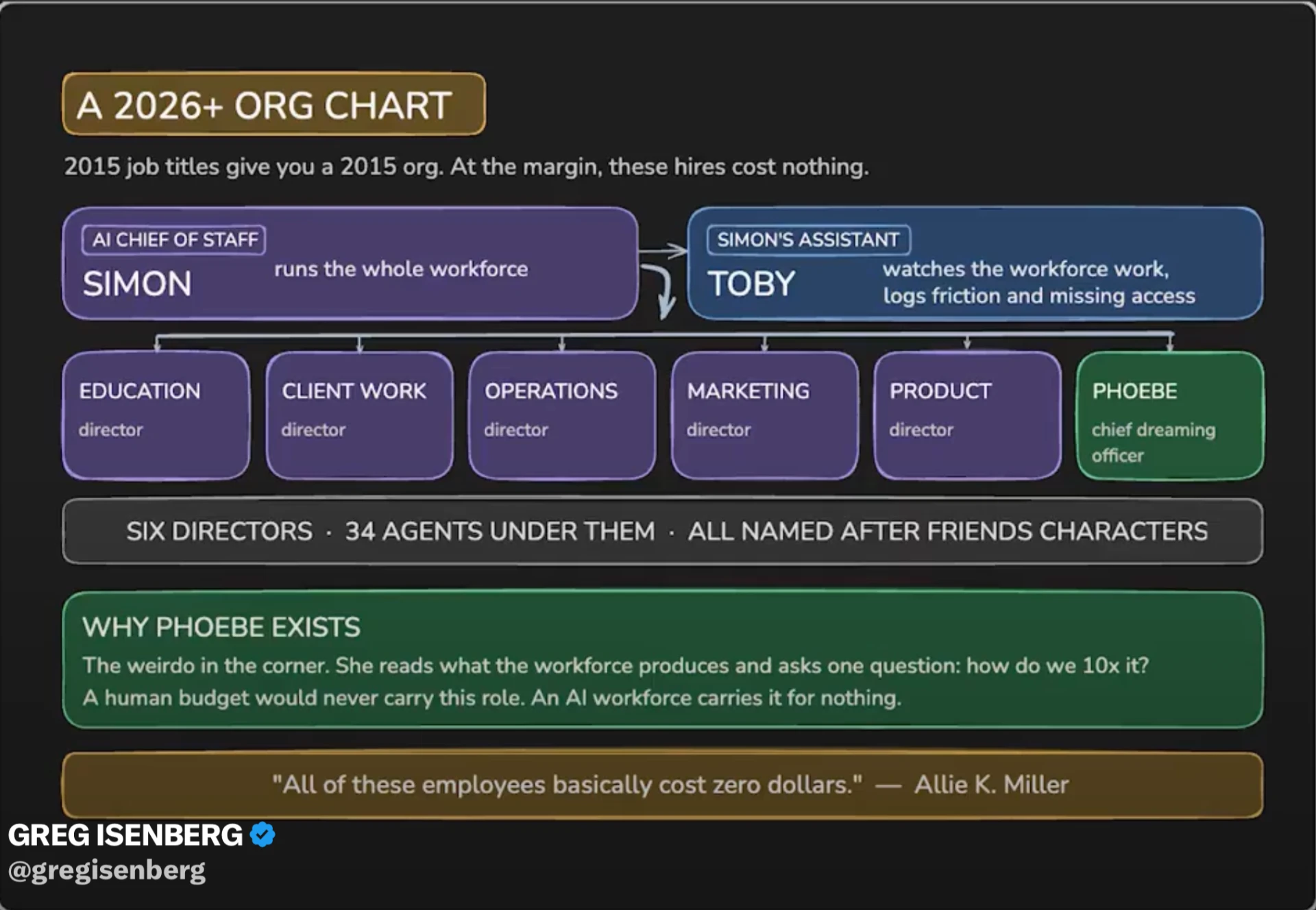
The org sits underneath. Simon, the AI chief of staff, runs the whole workforce on the biggest model she can buy, and she speaks to Simon alone. Six directors report to him on smaller models, one per business function, education, client work, operations, marketing, product, and one wildcard. The directors never talk to each other; Simon hands each one a clean brief and they stay in their lane. Below them sit specialized sidekicks on the smallest models. Two roles she says no human budget would ever carry are the ones she talks about most. Phoebe reads everything the workforce produces and asks how to make it ten times bigger. Toby watches the workforce itself, logging friction and missing access, down to noticing that she keeps correcting one agent's output and asking whether that agent simply lacks access to the right file.
The workforce is also multiplayer. Her human team can question it directly in a shared Slack channel, and when a teammate asks whether a client has answered her email, the workforce replies instead of everyone waiting five hours for Allie.
The famous prompt is three words, and it started as a confession. She realized she was functioning at the limit of her own imagination, with nobody positioned to manage her past it, so she handed that job to the workforce. Several times a day she tells it to do smart things, and the reason so short a prompt works is that the context under it is complete. Her agents read her business context docs, goals, meeting transcripts, email, calendar, Notion, Stripe, Supabase, and GitHub.
On top of the systems sits the part she says nobody codifies. Each evening she dictates a diary entry, five to forty minutes of what a client actually needs, what she decided over text, what she now believes and why. More than eighty entries are banked in a personal wiki her agents read. Written goals sit beside the corpus, and each quarter she reviews them with the workforce itself, so the new work it invents stays aimed at her actual ambitions. She is candid that trust took months. Early on, the system reported that Greg had confirmed an interview when the date was still being negotiated over text, and rooting out that class of error was the real setup cost. Her stated ambition covers all of it. She wants her whole company to be queryable.
Proactivity is the current obsession. The triggered automations are, in her words, the easy half. A screen recording lands in a folder and out come a transcript and nine social posts in her voice. The half she calls more interesting for the back half of 2026 is proactive work on undefined workflows, agents noticing what should happen without a playbook telling them. Her yardstick comes from Alex Lieberman's pyramid of proactivity, whose top level is an employee who has already solved the problem and already planned for the failure case. Her watchdogs live here too. One reads Slack for duplicated work, one reads the calendar for conflicts, one reads meetings for places where people actually disagree. She is blunt about dashboards, which tell you your follower count when what you need is what to do tomorrow, with the script already written.
Then the move I found most striking. When her team shipped a new product, the AI First Index, they refused to just build the thing. They built a small software factory first, primitives for login, payments, social sharing, and newsletters, so that the next product ships faster than the last. The first product is already profitable. Think of the factory behind the task, she says, instead of the task itself.
Hold all of that against the discipline underneath it. Her agents draft everything and send nothing. The autonomy has widened enormously, and the tier of risk has stayed exactly where it was. "I still check all the emails."
Taken together, what has she built? By her numbers, a rounding error of AI users run anything like this system, so even a basic workforce puts you near the top 1 percent. Mark Cuban's contribution to the workshop was the reminder that judgment stays the human moat, because AI does not know the consequences of its actions. And her own closing advice is disarmingly simple. Start with one agent, then a proactive one, then two working together, and let the system interview you the rest of the way. Lean into the weirdness.
Where does an organization take all of it? Part two answers that question. Her system runs on one person's remarkable discipline, and the enterprise version of that discipline is called infrastructure.
Next in the series: Part Two, "where the Agent Workflow Goes From Here in the Enterprise," on the six moves that carry these disciplines into an organization.