Where the Agent Workforce Goes From Here for the Enterprise
Part two of three. Allie Miller solved the company of one. The enterprise chapter is ready to be written, and her own language points the way.
Larry Chao · August 13, 2026
In part one I summarized Allie K. Miller's AI workforce, thirty-four agents run by one person with unusual discipline. I closed by saying the enterprise version of that discipline is called infrastructure. This piece is about what that means concretely, and every move the enterprise needs is already implied by something she or her interviewers said out loud.
Move one comes from her own analogy. If you are the electrical engineer for the building, then somewhere there is a building code. Nobody wires an office tower on talent and good intentions. The code says what is safe before work starts, the breaker trips on its own when the fault arrives, and the inspector signs a record anyone can check later. For an agent workforce, the code is written policy that travels with every request. A guardrail in a prompt is a request. A guardrail in the infrastructure is a rule. "Never send emails on my behalf" has to hold whether or not the author is watching, and across a hundred employees who each typed something slightly different.
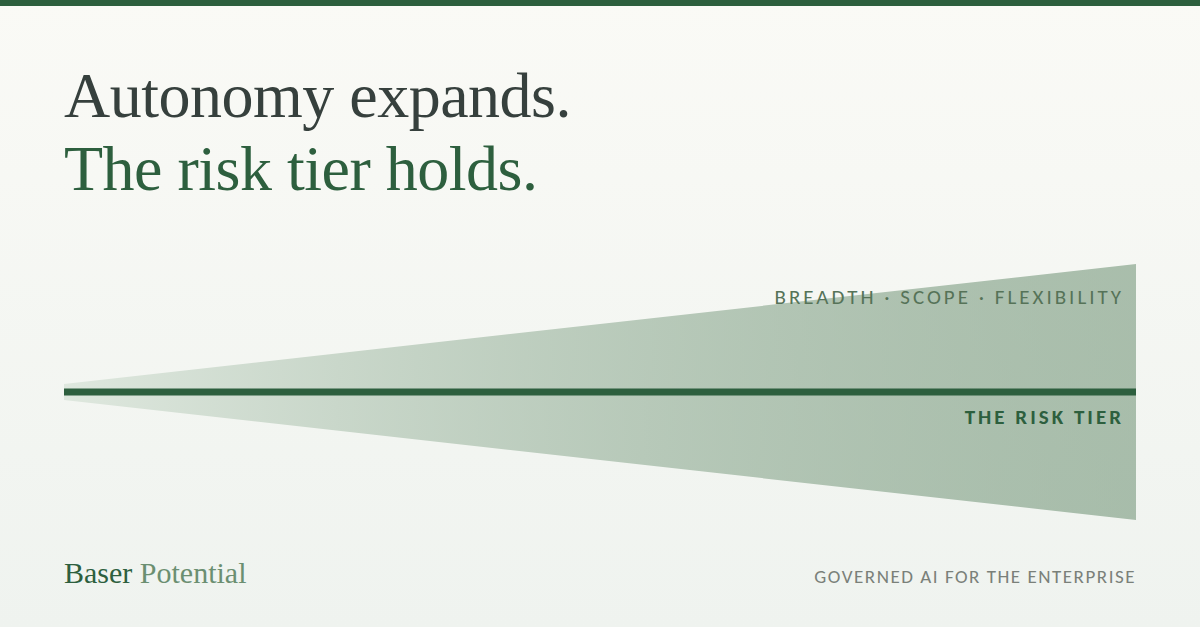
The second move answers the frontier she named herself, proactive work on undefined workflows. A workflow can stay undefined as long as the authority around it is defined. Give the agent a boundary that never moves, a trust class, the data it may read, the tools it may use, the moment it must escalate, and inside that boundary it can improvise all day. The freedom is real because the fence is real. Unrequested work stops being scary once every piece of it still enters through the same door and shows up in the evidence record.
Move three is her queryable company, grown up. For one person, queryable means the agents can read the wiki. For an organization, queryable means you can ask why an action happened, under whose authority, in service of which decision, and receive an answer with receipts. Her diary only hints at the two requirements. Intent has to live in structured, versioned form that outlives any single author, and evidence has to be recorded at the moment of action rather than reconstructed later. Her eighty diary entries are the seed. The grown version is a registry of intent plus an evidence record, and it settles arguments a wiki cannot, because two vice presidents believe different things and a company needs one fact with one owner.
The fourth move upgrades her factory. Build the factory before the product is exactly right, and her primitives are login, payments, social sharing, and newsletters. The enterprise factory needs one more shelf. Alongside login and payments belong authority, approval, and evidence, primitives like any other. A product built on that shelf needs no governance retrofit later.
Move five unblocks the watchdog. She is right that AI watching for duplicated work, calendar conflicts, and quiet disagreement is one of the best use cases available, and right that almost nobody runs it. The reason is access rather than laziness. A watchdog is only as good as what it may read, and no serious enterprise hands one reader everything without knowing what gets read, for what purpose, with what record. Cross-functional gap analysis has been the best open use case in AI for ten years because the blocker was never imagination. Once the reading is governed, the watchdog can finally be turned loose on the whole company.
The sixth move pays for the other five. Miller's first question about any AI replacement is who is liable now, and the enterprise moat, by Isenberg's own definition, is someone to call and someone to blame. An agent workforce has neither until you install them, meaning named reviewers, approvals that bind to a specific action, and evidence someone can stand behind in a dispute. That layer is what turns free labor into something a board can live with, because when execution costs nothing, governance becomes the scarce factor of production.
Everything above is what her story grows into when the company stops being one person. The disciplines stay the same, the risk tier holding, the context complete, the company queryable, and each one moves from a habit in someone's head into infrastructure that holds by default. One remarkable person can run all of it from memory. An organization cannot, and no organization should have to try.
That second half is the work we do at Baser Potential. If your team is somewhere between the mindset shift and the infrastructure, I would enjoy comparing notes.
Previously: Part One, "The Company of One, Running Thirty-Four Agents", a full tour of Miller's system. Next: Part Three, "One Workflow, Three Tracks, Ninety Days," the method we use to build the enterprise version.