The Questions Boards Have Not Asked Yet
Notes from SVEN's CXO and AI panel, featuring Baser Potential co-founder Tobias Yergin
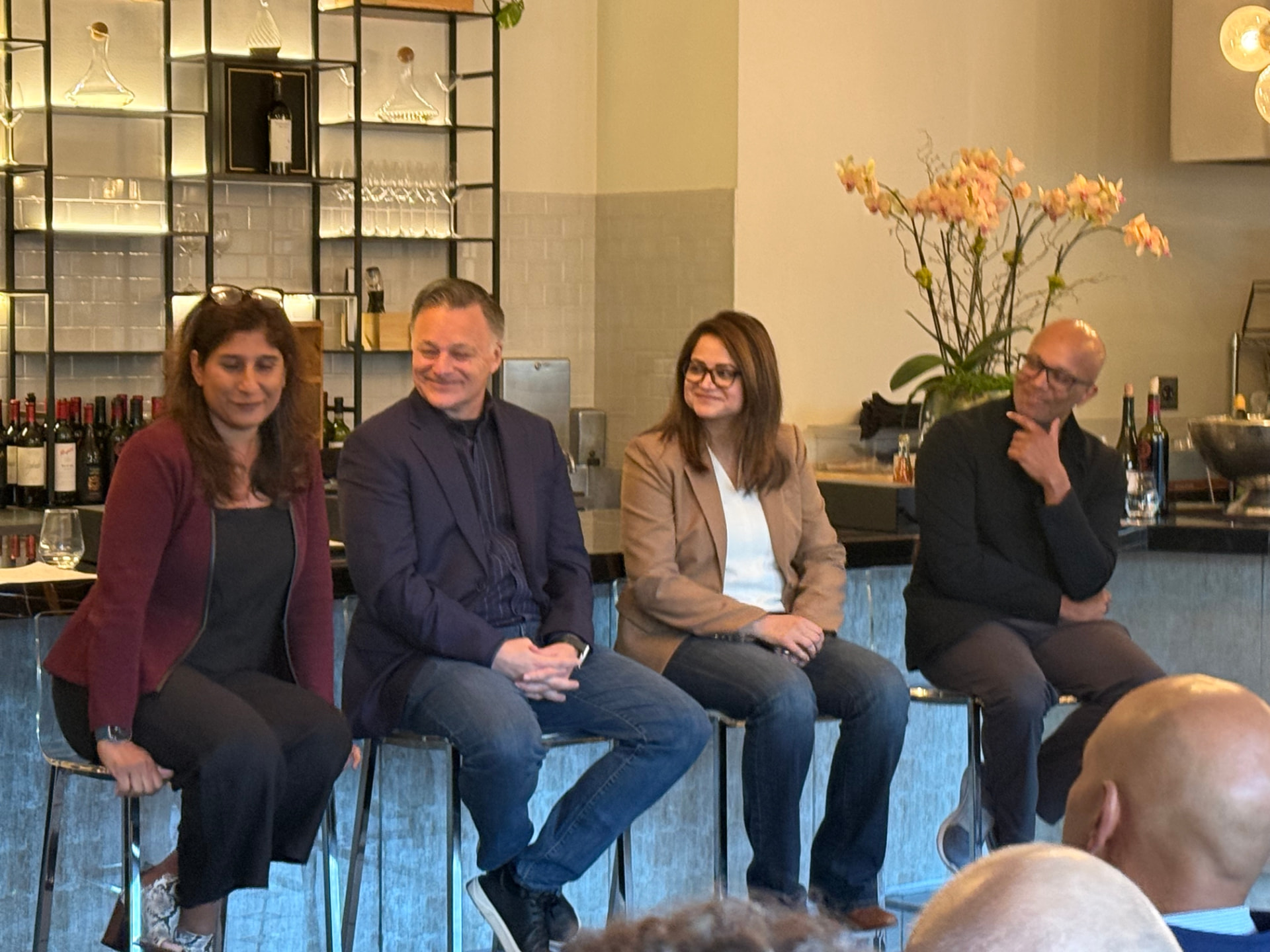
On November 10, SVEN, the Silicon Valley Executive Network, gathered executives, investors, founders and engineers in Mountain View to open a new monthly series on what CXOs are watching and where AI is heading. Brian Reynard, who founded SVEN twenty years ago, assembled a panel that spanned enterprise software, retail technology, health tech and energy.
- Charu Madan, EVP BD and Partnerships, Navina (moderator and panelist)
- Bhawna Singh, CTO, Lightspeed Commerce
- Praveen Mandal, Co-founder and CEO, JoulesAI
- Tobias Yergin, Co-founder, Baser Potential
Tobias has spent thirty years in the Valley, most recently running AI research at Walmart for three years before co-founding Baser Potential. He spoke on agent governance. The other panelists came at the same questions from commerce, identity, partnerships and the power grid, and their answers kept converging on the problems Baser Potential exists to solve.
Efficiency is the floor
Charu opened by setting a higher bar for the evening. Using AI to write faster and click less is table stakes, she said, and she asked the panel for examples of work that was impossible before.
Her own example came from partnerships. Navina operates across the United States and Israel, so much of the R&D conversation happens while she sleeps. She built Claude agents that read across the company's Slack channels and surface partnership opportunities she would otherwise have missed. Her role has shifted in another way too. Where she once spent hours drafting a deck or an investment thesis, she now reviews drafts that are 95 percent correct, and the remaining 5 percent can be badly wrong.
Most boards cannot answer the first question
Tobias brought numbers from the field. Over the past sixteen months, the Baser Potential team has held more than a hundred conversations with board members and CEOs. Most have not run a risk assessment on the agents their company uses. Most cannot say how many agents they have, and most do not know which of those agents are running in production.
Agents in production act on behalf of the company, so the company carries liability for what they do. A director who has not asked about them has a fiduciary gap, whether or not anything has gone wrong yet.
Those conversations are why Baser Potential's broader work centers on five questions every board should be able to answer about its agents.
- Which agents are operating, including those embedded in third-party software?
- What can each one access, decide and change, and which limits are actually enforced?
- Who is the named person accountable for each agent?
- Can you reconstruct what an agent did, end to end, from retained records?
- What is the business exposure if an agent misbehaves, and how long would it take to stop?
Phase two is ROI
Bhawna described the first wave of enterprise AI as a productivity story. Six months ago she faced a flood of pull requests and releases, with engineers proud of how fast they were shipping. The question she had to ask was who was buying any of it. When building software gets cheap, the hard leadership decision moves to what to build, on what timeline and for what return, and it takes discipline to stop work that is not paying off.
Commerce taught her a second lesson. She arrived at Lightspeed assuming merchants wanted cost reduction first. They wanted time back first, cost relief second and revenue growth third. When Lightspeed asked its first merchants what they would do with new AI capabilities, they said they would unplug them. A few months of education later, some of those merchants were asking to pay.
Tobias added the competitive side of the ROI question. A competitor running agents in production that ships five sellable features a month against your one opens a gap that widens every month. AI-native startups chase a benchmark of ten people reaching $100 million in revenue within three years, without the overhead, politics and span of control an established company carries. Customers deploying their own agents need fewer seats. The frontier labs are moving up the stack into applications as model capability becomes good enough for most knowledge work, so a software company can find itself competing with its own model supplier.
The bottleneck moves to the specification
Tobias used a simple image. Squeeze a long balloon in the middle and the air rushes to both ends. Companies that optimize their development pipeline with coding agents find their constraint moves the same way, out to product and specification. More code ships, but more code does not guarantee better outcomes, and in his experience a company without strong AI product managers is running agents without good specifications.
Praveen put the same point in engineering terms. A strong engineer who knows how to debug what these tools produce becomes far more productive. A weaker engineer ends up less productive, without the skill to judge whether the generated code is any good. Bhawna saw the same split at Lightspeed, where senior engineers and architects gained first and junior engineers needed coaching to take ownership of the code they generated.
That constraint is why Baser Potential treats the specification as the unit of work, with each step checked before its output moves downstream.
Trust needs visibility
For Bhawna, trust is the issue that runs through every industry she has worked in. At Okta, customer conversations kept returning to brand and trust, and at Lightspeed the same concern shapes the merchant conversations. A company can only extend trust to its customers when it can see what is happening in its own environment, whether that capability is called observability, visibility or governance. Security spending rarely shows an immediate ROI, so leaders have to build the narrative that earns the budget.
Tobias described what the governance layer has to contain. Observability shows what agents are doing in real time. An evidence plane stores every action and decision as a system of record, so a postmortem can replay exactly what happened. Trust boundaries mark where a human must approve before work proceeds.
He then described a mistake Baser Potential sees in client environments. A company ties each agent's identity to a person through its identity provider and assumes the agent should inherit that person's permissions. That assumption fails. An agent working toward a business objective takes a sequence of actions its sponsor would never take, and the order of those operations can create exposure that no single permission check catches. Access control for agents needs role-based and attribute-based rules written for the agent, covering which systems of record it can reach and which personal data it can see.
Bhawna pointed to the next gap. Security teams today concentrate on putting controls on agents, auditing them and assigning accountability. Far fewer are working out how to use agents to defend against other agents.
No undo button
Praveen's company, JoulesAI, orchestrates batteries, solar and other energy assets. When an AI system makes a bad dispatch decision on a battery, the charge is gone, and there is no rollback. His team has published a paper arguing that an autonomous grid needs contextual guardrails that allow or block each decision based on the situation at that moment.
He also sees room for AI to give back some of the power it consumes. The grid was built for peak load, and on average about half of it goes unused. AI training and inference place different, flexible demands on that capacity, and idle charging stations at EV depots are one example of supply waiting for a use. Flexible load matched to flexible supply is an efficiency opportunity.
The no-undo principle applies well beyond energy. Wherever an agent acts on something that cannot be reversed, governance has to sit in front of the action.
How Baser Potential sequences the work
Tobias laid out the path Baser Potential takes with clients in four stages.
- Assess readiness. Start with a risk assessment and establish where the company sits on AI readiness.
- Build with agents. Almost every client wants to ship more code, so the work moves to building with agents, which is where the specification becomes the constraint.
- Govern in production. Next comes the governance layer, so agents in production are observable, bounded and on the record.
- Build a self-improving company. Frontier models now help with their own pre-training, code, post-training and research, and Tobias told the room that recursive self-improvement is already happening. Baser Potential believes its architecture can give each client a system that lets the company improve itself the same way.
A not-yet mindset
Tobias described three forces that make planning hard. Frontier model releases have gone from yearly to quarterly to monthly and now arrive every couple of weeks. Each release adds capability that most users have not yet learned to use. Those gains compound on one another. People plan in straight lines, and this curve bends upward.
His advice to clients is to develop a not-yet mindset, because something out of reach today may arrive far sooner than a linear plan assumes.
More engineers, not fewer
The evening closed on jobs and public anxiety about AI. Tobias speaks regularly at San José State and Cal Poly, where students worry about their future. The conversations Baser Potential has with CFOs and CEOs point elsewhere. A company can use these gains to cut 30 to 40 percent of its engineers and hold output steady. It can also keep the team, make a few strategic hires and ship five times as many features. Many of those leaders want to hire more engineers.
Bhawna confirmed the hiring side from her seat as a CTO. She is eager to hire engineers with strong agentic and AI skills, and she cannot find enough of them. She also sees companies in new markets looking for leaders who have already been through AI adoption.
Tobias's advice to students is to build agency, resilience and an entrepreneurial habit. With those three and today's tools, a person in their mid-twenties can start a small company and make a living from it. He also drew a line around what remains human. Models have intelligence, and people have wisdom, which comes from experience and consequence. Until machines can learn continuously from the physical world, judgment about what to build and when to stop stays with people.
The thread through the evening
Each panelist arrived at the same requirement from a different direction. A merchant, a CISO, a grid operator and a board member all need to see what their agents are doing, decide where a human must step in, and keep a record that holds up afterward. Baser Potential builds that capability for companies putting agents into production.
Thanks to Brian Reynard and SVEN for hosting, and to Charu, Bhawna and Praveen for sharing the stage with Tobias.
By Larry Chao, Co-founder and Managing Director, Baser Potential