Beyond Productivity
A governed path up the AI value ladder.
Larry Chao and Tobias Yergin
Most PE-backed companies have adopted AI by now, yet many owners are still waiting to see it in the numbers. That gap now carries a real cost. Private equity faces long exit backlogs and modest returns, so revenue growth and efficiency now carry more of the value story.
A June 2026 McKinsey study of 471 PE-backed companies offers an explanation. It sorts companies into four levels of AI maturity: opportunistic adoption, operating-model enhancement, AI built into products, and new AI businesses. The median revenue multiple climbs from 13x at the first level to 31x at the fourth, and nearly all of that climb comes after level two.
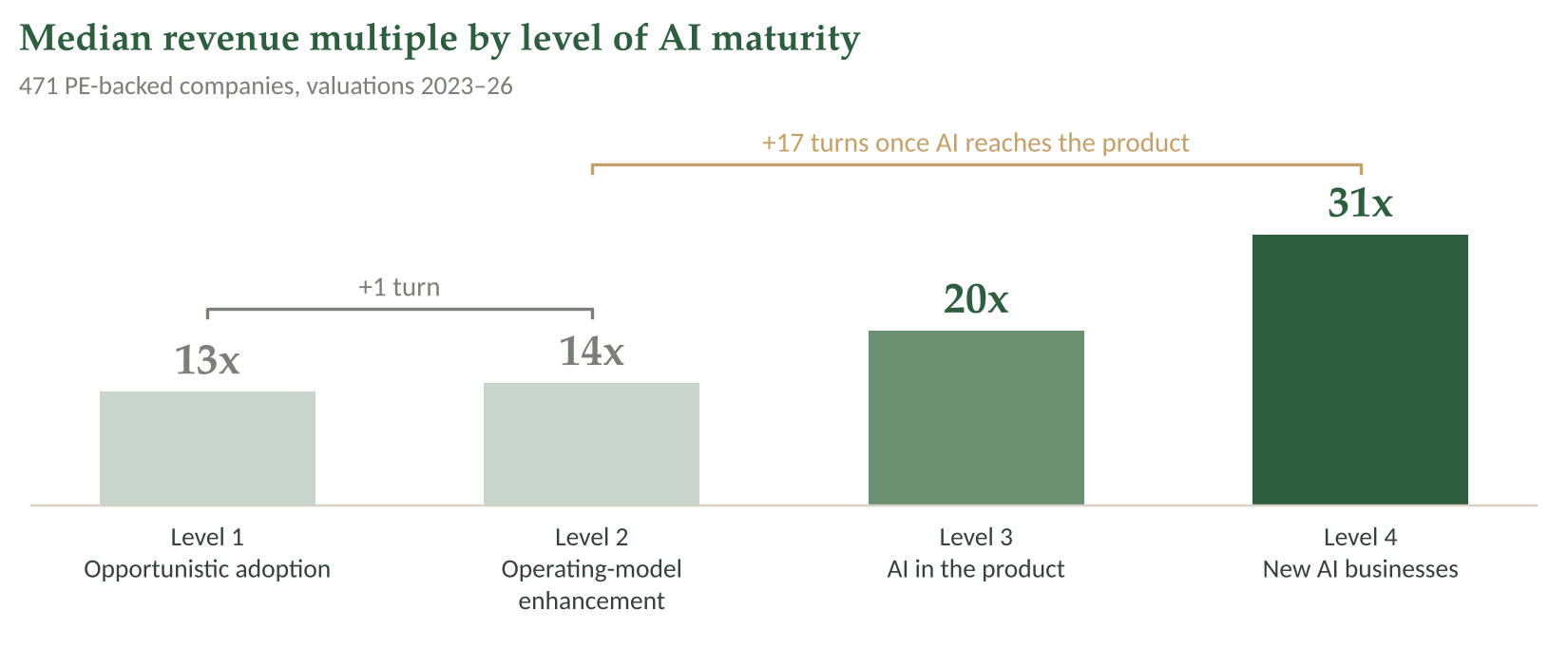
The flat stretch at the bottom deserves a leadership team's attention. Moving from level one to two lifts median revenue per employee about 19%, from $99K to $118K, yet adds a single turn of multiple. Markets pay when AI changes what a company sells: 20x at level three and 31x at level four, where revenue per employee reaches $180K. Software companies show the widest spread, at 24x and 33x.
That could read as advice to skip operations and go straight to product. The study points the other way. McKinsey's readiness markers for level three are proprietary data that competitors cannot copy and an operating model where product, data and engineering work as one team. Level two, in its account, needs clear limits on where AI acts alone, human oversight, and controls for exceptions. Governed operations build every one of these. Agents that run real workflows under clear rules leave behind clean, owned data and a team that knows how to ship AI safely, and a product bet stands on that base.
Many companies stall at level two for a structural reason. At this revenue scale, often no one owns internal operating infrastructure, so AI work defaults to the product team, which is busy shipping the product. Slow adoption is usually a question of ownership. Competence is rarely the gap.
AI makes you faster. Governance keeps you that way.
The agent projects that stall tend to fail on the work around the model. The ones that last start with a single workflow slice, with real volume, written rules and a customer waiting at the end, and the team fixes the process before automating it. They draw the trust boundary before writing any prompt, so disputes, legal threats, requests for a person and amounts over a limit reach a named human with the full history. They connect the agent to the system of record with real permissions and an audit trail, which is where most of the effort goes.
The same teams set the baseline and pass thresholds before building, then test against last month's real cases. They know the cost per case before launch and cap it. The code lives in the company's own repo and cloud, with an exit path agreed up front. They run one slice for a month, track one number such as cycle time or cost per case, and widen once it holds. Each step leaves a record, and those records become the data and operating discipline that level three requires.
“Don't build the thing, build the factory to make everything.”
Baser Potential helps PE-backed software companies build this kind of governed operating model, in two stages. Incubate opens with an executive workshop and a readiness self-assessment across eight domains, names the known blockers, and scores candidate workflows. It closes with a first workflow slice and a clear go-forward decision. That slice arrives with its baseline, trust boundary and verifier path already set. Accelerate then runs three tracks at once. The software factory speeds engineering through spec-driven development, the first workflow goes into production, and the system of intelligence governs it and records what each agent did and why. Your team builds alongside ours and owns the result.
The simplest first step is a 45-minute conversation about where your company sits on the ladder today and which workflow should come first. You can book a time at bit.ly/basercal. For leadership teams ready to go further, we run a working session where the CEO, CTO and an operating lead score candidate workflows against their own volume, rules and data.
Source: McKinsey & Company, Beyond productivity: How AI creates value in private equity, June 2026. Sample of 471 PE-backed companies, $1M–$250M revenue, valuations 2023–26.